

Time: 3 weeks
Project Type: Client
Team: 3 Designers – Max, Britni, and Emily
Deliverables: Online training platform
The Client

Advocates for Children – CASA is a nonprofit based in Parker that serves to speak up for abused and neglected children through court appointed special advocates or CASAs. Advocates for Children is a chapter of the National Court Appointed Special Advocate Association.
CASA recruits, trains, and supports community volunteers who advocate for children who have open dependency & neglect cases, truancy cases, need additional education advocacy, or are an adolescent that may need some additional support.
The Brief
To pivot their New Volunteer Training program from in-person to online. (Do to COVID-19) They have an in-person training curriculum that they have had much success with but struggled to convey comparable quality into the new online version.
Our Initial Thoughts: Sifting through the current training option, we discovered the online training platform was in much need of improvement. It wasn’t intuitive or well organized. For a trainee to find all the required materials, syllabus, and lessons they had to go to up to 3 different pages and even then there was missing or incorrect information.
The Original Training Platform
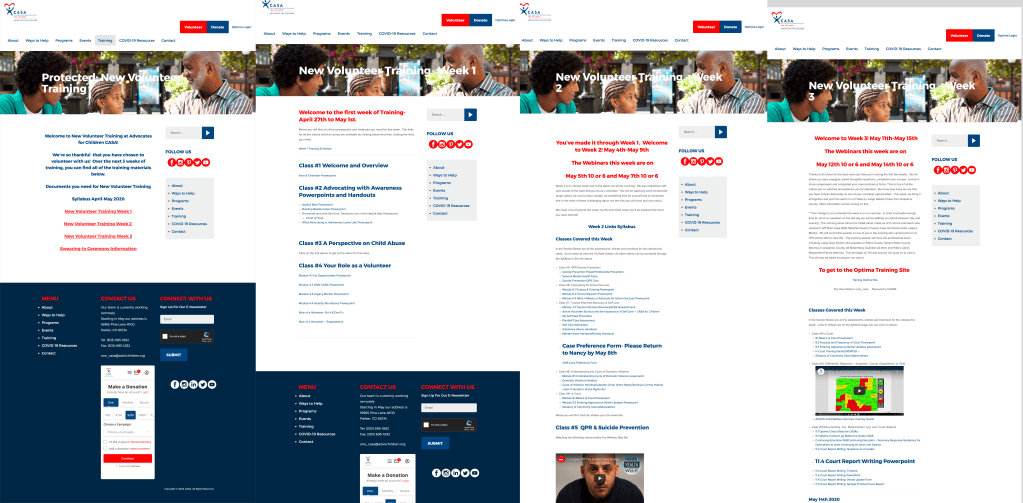
The original training platform was a series of pages and links. The hierarchy changed from week to week. As a volunteer, once you learned where the training pieces were for week one, they would be in a different place for week two and week three. One thing you not see from the website is that the volunteer coordinator was also sending out weekly emails with all the details and links. The emails were took her hours to craft and ultimately she was sending an email version of the pages you see above.
Taking a look at the original site you can see the back and forth the volunteers had to navigate as they were trying to find what needed to be done and when.
Original Site Map

Research
Competitive Analysis
To accomplish the goal of creating a user friendly manageable training platform our team wanted to see what was already on the market. This is what we found.

Most of these learning platforms are extremely expensive and cater more towards large universities.
Surveys
Our clients have run one online training program before soliciting our expertise so we were able to utilize their Survey monkey results from the previous Volunteer graduating class. From there we created another survey to dig deeper into what would make the training experience better. The results from the first survey seemed very forgiving.
CASA had just completed one, 3-week online training course for 26 new volunteers.
They gave us their SurveyMonkey results from a series of surveys they ran throughout that 3-week period.

Most of the CASA volunteers were over the age of 50.

Also, most have used another online training program in the past.

37.5% of our users found the information was fairly organized on the original website.
Here are a couple of the comments from the SurveyMonkey results.
“I felt the syllabus was nice to have but I appreciated Nancy sending an email prior to each lesson to verify what information we needed to complete.”
“My only complaint is that between the syllabus and what was listed for training online, it was often confusing to figure out what was due for the next webinar”
“The syllabuses were very helpful, but sometimes it was hard to navigate the volunteer training page on CASA’s website. I got confused on what was expected to be completed.”
Original CASA Surveys
Solution
We found Google Classroom, an existing online classroom platform, that “Helps students and teachers organize assignments, boost collaboration, and foster better communication.”
Working for a nonprofit without a Dev Team, we knew that if our final deliverable needed to be a quick, simple, and almost seamless option so that CASA would be able to easily manage.
And our research supports this, our new survey showed that the majority of the volunteers have a gmail account and have used Google products.


New Site Map

It was really important for us to create strong information architecture. There is quite a bit of content but after organizing the lessons we were able to find patterns and lessons that built on each other. We were able to add due dates and structure to help the volunteers focus on the content and not have to worry about how to get the content.

Conclusion
In the end we were able to deliver a free, ready to use and easy to learn platform to CASA to continue training in volunteers during the quarantine. In addition, we were also able to provide them with instructional training videos and training manuals for future instructors.
 Emily Peconi | UX Designer